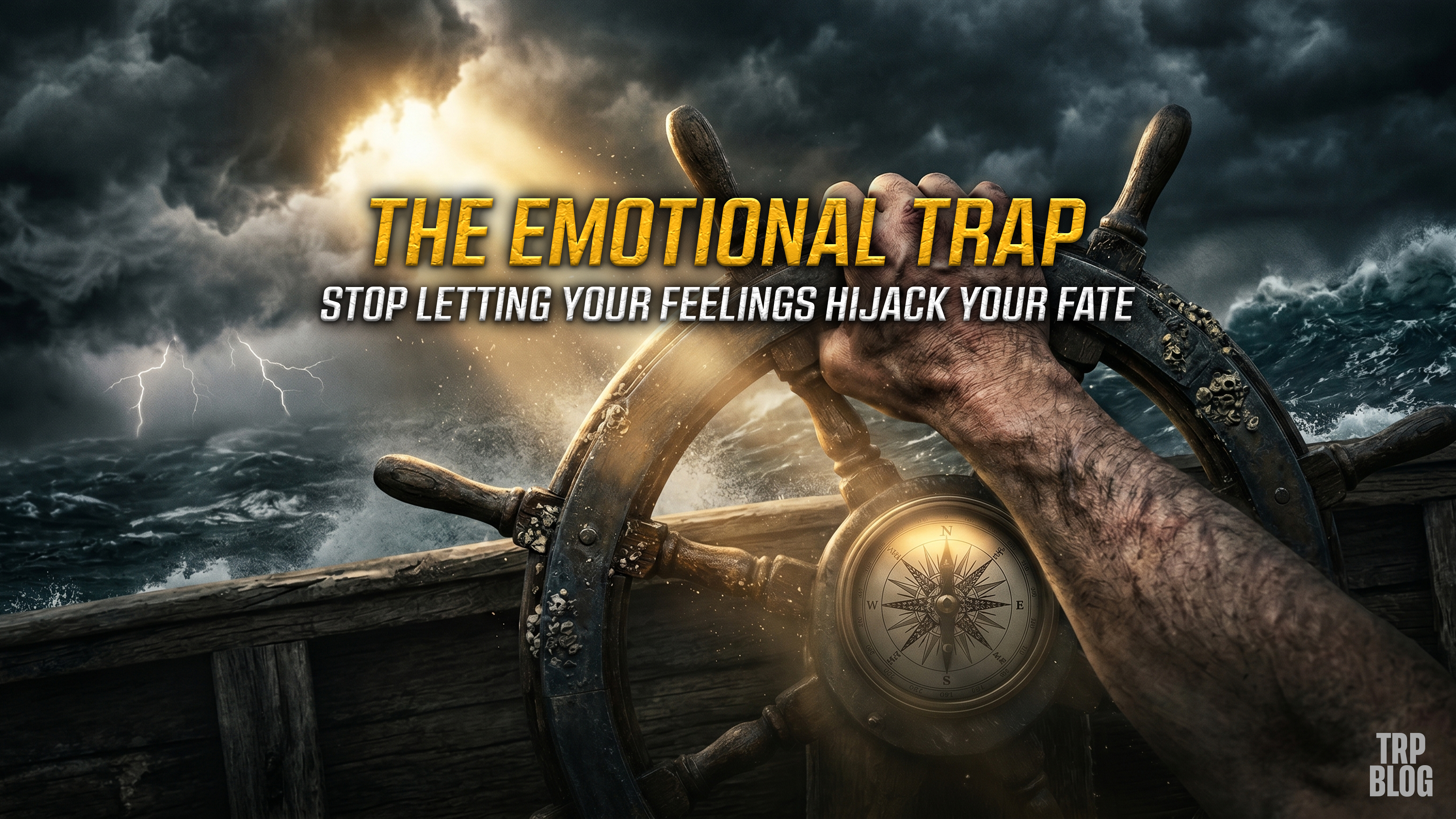
The Emotional Trap: Stop Letting Your Feelings Hijack Your Fate
We all like to think of ourselves as highly rational, logical creatures. We believe that when it comes to our businesses, our relationships, and our life goals, we are making calculated, intelligent choices.
But science and psychology tell a very different, deeply uncomfortable story.
Harvard Business School professor Gerald Zaltman found that 95% of our decisions are made subconsciously, driven entirely by our emotions. Not logic. Not a spreadsheet of pros and cons. Not rational thought. Feelings.
Let that sink in.
Almost every choice you make today—what you eat, whether you make that extra sales call, whether you hit the gym, how you speak to your spouse—is fundamentally at the mercy of your ever-fleeting, incredibly fragile emotions.
If you are not consciously aware of this, your life is like a lost vessel at sea, completely dependent on the unpredictable wind and the tide. If the wind is blowing in a positive direction, you move forward. But the second a storm hits, you are tossed against the rocks.
To live a relentless life, you cannot be a passenger on that ship. You have to take the helm.
The Feedback Loop: How Feelings Build Your Future
We have all felt that supreme, fiery motivation to achieve something more. You listen to a podcast, you read a book, or you hit a breaking point in your life, and you declare, "Things are going to change."
But for most people, that drive fails within a few weeks. The diet ends. The business plan is shelved. The running shoes gather dust. Why?
Because motivation is just a feeling. And feelings change faster than the weather.
Here is the dangerous cycle of human behavior: Feelings lead to choices. Those choices create results. Those results generate new feelings. And the cycle repeats.
If you wake up feeling tired (Emotion), you choose to hit snooze and skip your workout (Choice). Because you skipped your workout, you spend the rest of the day feeling sluggish, guilty, and disappointed in yourself (New Emotion). That guilt makes you crave comfort, so you eat a junk-food dinner instead of a healthy one (New Choice).
It is a downward spiral, and it happens on autopilot.
However, this cycle can be weaponized for your benefit. If you force yourself out of bed despite feeling tired (Choice overriding Emotion), you crush your workout. Afterward, you feel energized, proud, and unstoppable (New Emotion). Because you feel unstoppable, you tackle your hardest work project before noon (New Choice).
This is the upward cycle. This is where greatness is forged. But to trigger the upward cycle, you have to severe the link between how you feel and what you do.
Real World Realities: The Cost of Emotional Choices
Let’s look at how this plays out in real f*cking life.
The Market Panic: Look at investing and business. When the stock market takes a sudden dive, the logical, historical truth is that the market eventually recovers, and downturns are often buying opportunities. But what do 95% of amateur investors do? They feel fear. That fear dictates their choice: they panic-sell at the absolute bottom, locking in massive losses. The relentless, seasoned investor feels that same fear, acknowledges it, ignores it, and buys more.
The Entrepreneur’s Rejection: Imagine you are starting a business and you pitch a massive client. They don't just say no; they laugh you out of the room. The immediate feeling is humiliation, anger, and inadequacy. If you let that feeling drive your choice, you will quit your business, or you will send a highly emotional, bridge-burning email to that client. If you override the emotion with logic, your choice is to calmly analyze why the pitch failed, refine your offer, and pitch ten more people the next day.
The Space Between Stimulus and Response
Psychiatrist and Holocaust survivor Viktor Frankl wrote one of the most powerful observations in human history in his book, Man's Search for Meaning:
"Between stimulus and response there is a space. In that space is our power to choose our response. In our response lies our growth and our freedom."
The "stimulus" is your feeling. The "response" is your choice.
Most people have zero space between the two. They feel angry, so they yell. They feel unmotivated, so they quit. They feel scared, so they run.
Relentless people expand that space. They feel the fear, the exhaustion, and the doubt—because they are human, and we all feel it—but they pause in that space. They look at the emotion, step over it, and execute the mission anyway.
"Captain of My Soul"
In 1875, the English poet William Ernest Henley was suffering from severe tuberculosis of the bone. He had already had one leg amputated below the knee. When doctors told him they needed to amputate his other leg to save his life, Henley refused. He sought a second opinion and underwent multiple grueling, painful surgeries to save his remaining leg.
While recovering in his hospital bed, facing unimaginable pain, depression, and a highly uncertain future, Henley did not let his feelings of despair dictate his spirit. Instead, he wrote the famous poem Invictus (which translates to "Unconquered"). It ends with these two immortal lines:
"I am the master of my fate,
I am the captain of my soul."
He refused to be a lost vessel tossed by the tide of his tragic circumstances. He took the helm.
You cannot control the initial emotions that pop into your head. You cannot control the weather, the economy, or the unfair hands life deals you. But you are in absolute, 100% control of the choices you make in response to them.
Stop letting a temporary emotion assassinate your permanent potential.
THE CALL TO ACTION
I want you to identify one specific area of your life where your feelings are currently hijacking your fate.
Are you putting off a difficult conversation because you feel anxious about the confrontation? Are you avoiding launching your project because you feel the fear of failure? Are you skipping the gym because you feel tired after work?
Your challenge for the next 24 hours is to catch yourself in that exact moment. Find the space between the feeling and the choice. Acknowledge the emotion, say out loud, "My feelings do not dictate my actions," and deliberately make the logical, difficult choice anyway.
Take the helm. Put your hands on the wheel. Start your upward cycle today.
Until next time... Stay Relentless.
Nobody's Coming to Save You: The Brutal Reality of Ownership